Palette Inpainting Diffusion Curriculum Reinforcement Learning (PIDCRL)
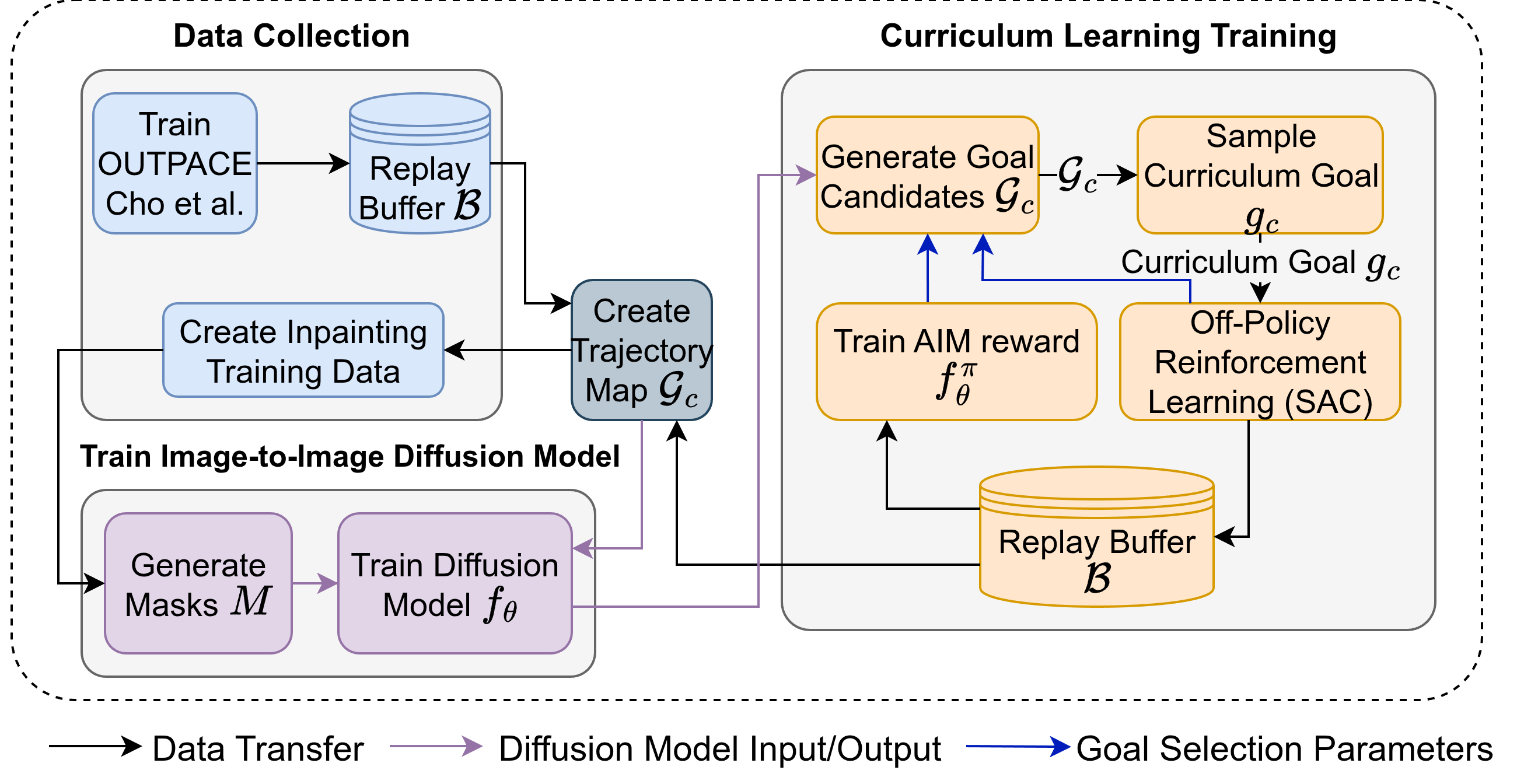
Curriculum reinforcement learning (CRL) aims to accelerate agent learning by organizing tasks into a sequence of progressively harder challenges. However, many existing CRL methods struggle to steer agents toward meaningful exploration targets, especially when domain knowledge or hand-tuned heuristics are limited or unavailable.
To overcome this limitation, we introduce PIDCRL, a diffusion-based CRL framework that leverages a mask-conditional, image-to-image pretrained diffusion model (Palette) to automatically generate curriculum goals from agent trajectory heatmaps. Given a heatmap trajectory as input, the model produces candidate curriculum goals, which are subsequently filtered and selected using several strategies, including spatial averaging, $Q$-value scoring, and a trainable reward-based mechanism.
These strategies identify curriculum goals that are both achievable from the current trajectory and appropriately challenging, enabling effective curricula without requiring expert-designed heuristics. Across three maze environments (PointUMaze, PointNMaze, PointSpiralMaze), PIDCRL matches or outperforms ten state-of-the-art CRL baselines.
Diffusion Inpainting for CRL
Repurposes Palette image-to-image conditional diffusion to in-paint prospective goal locations directly onto visual agent trajectory heatmaps.
Strategic Goal Selection
Introduces $Q$-value scoring, spatial averaging, and trainable adversarial intrinsic motivation (AIM) filtering to pick frontier goals that avoid exploration traps.
Superlative Performance
Outperforms 10 state-of-the-art CRL baselines (including OUTPACE, GoalGAN, HGG, CURROT, and GRADIENT) across PointUMaze, PointNMaze, and PointSpiralMaze.
Trajectory Heatmaps to Curriculum Goals
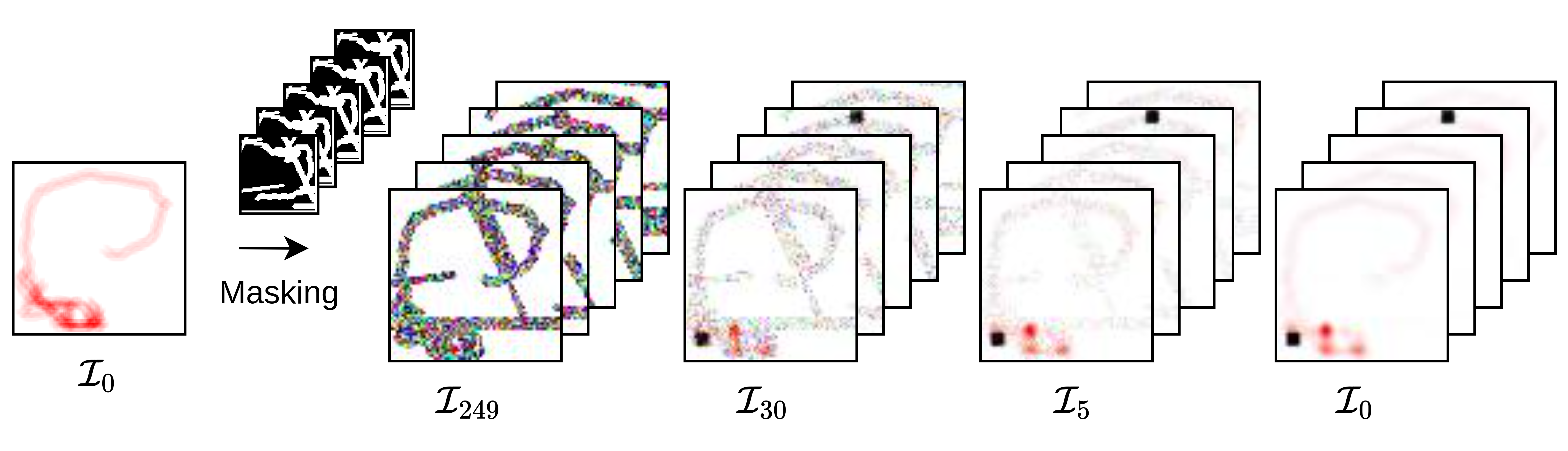
Instead of operating in low-dimensional Euclidean coordinate space where obstacle topology is neglected, PIDCRL maps trajectories into 2D continuous density heatmaps. A binary mask isolates the region to be inpainted by the conditional diffusion network:
Curriculum Goal Propagation Across Mazes
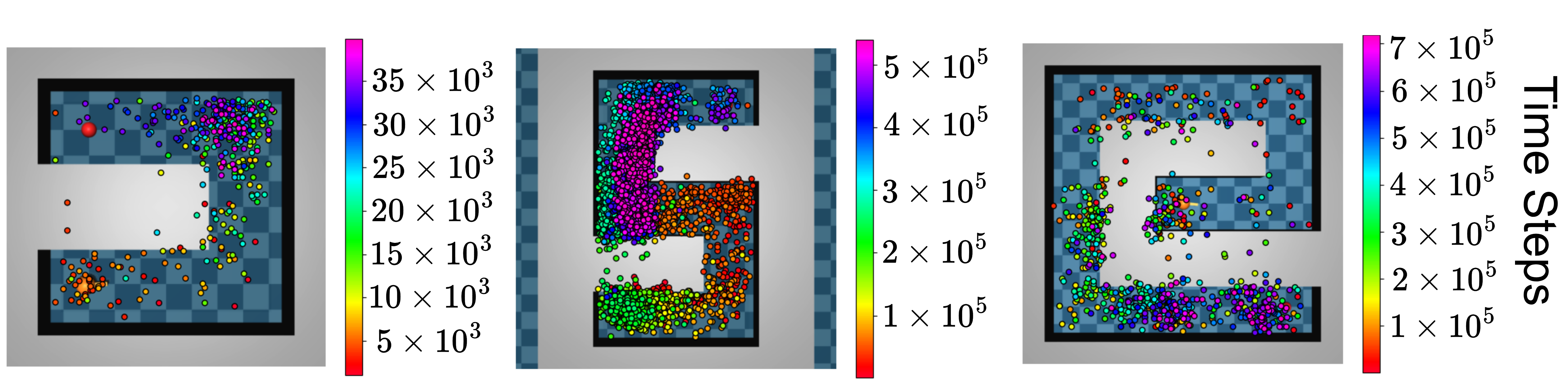
As the policy evolves, the diffusion inpainter smoothly extends goals along reachable topological corridors, preventing goals from being placed behind insurmountable walls.
Benchmarked Against 10 CRL Baselines
We evaluated PIDCRL against a comprehensive suite of ten established CRL algorithms across 5 random seeds:
Official Code & Supplementary Materials
Full PyTorch implementation, training scripts, MuJoCo environments, high-resolution plots, and supplementary analyses:
View GitHub Repository (farukoruc/DiffusionOutpace)If you find PIDCRL or this codebase useful for your research, please cite our IEEE WCCI 2026 paper:
@inproceedings{oruc2026palette,
  title     = {Palette Inpainting Diffusion Curriculum Reinforcement Learning ({PIDCRL})},
  author    = {Oru{\c{c}}, Faruk and Sayar, Erdi and Iacca, Giovanni and Knoll, Alois and Kayacan, Erdal},
  booktitle = {IEEE World Congress on Computational Intelligence (WCCI)},
  year      = {2026},
  publisher = {IEEE}
}